
Personal Phone Experiment: Switch from Smartphone to Dumb Phone
A practical template to run a 7–30 day experiment and learn what your phone use actually does to your focus, mood, and daily habits.
Before you start
- Pick a duration: 7 days (test) or 30 days (real insights).
- Set your “non-negotiables”: what must keep working for daily life.
- Plan your replacement tools: what will replace smartphone-only functions.
- Decide the rules: full switch, or “smartphone allowed only for X minutes/day”.
- Tell 1–2 people: so they don’t panic when you reply slower
Common non-negotiables (examples): bank payments, Smart-ID / identity confirmation, maps, tickets, work chat, two-factor authentication.
Quick self-audit (5 minutes)
Answer these before changing anything. This is your “baseline”.
- What do you use your phone for the most (top 5)?
- Which functions are required to function in society (for you)?
- Which apps trigger the most “automatic checking”?
- When do you use it most: morning, work breaks, evening, in bed?
- What do you hope changes: focus, sleep, mood, productivity, anxiety, social connection?
Download the template
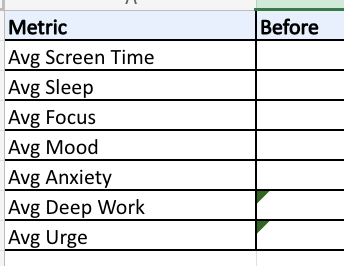
The template includes: baseline questions, daily check-ins, a weekly reflection, and a final “what changed” summary.
Disclaimer: this is only a template. For the best results edit the sheet or contact us for quotation if you are running a wider project and would like an integration into your organisation/personal project.
What phone should I use?
Any dumb phone / flip phone works. The key is removing the “infinite feed” and app switching. Even a smartphone in airplane mode doesn’t recreate the same friction.
What if I need Smart-ID / banking?
Plan the workaround first: desktop banking, scheduled “admin windows”, or keeping the smartphone as an emergency tool with strict rules (no socials).
How do I know it “worked”?
Track one or two outcomes: sleep quality, focus blocks completed, mood stability, or how often you feel the urge to check a phone that isn’t there.